Two units in the same kitchen, a Sub-Zero column and a Wolf oven, both playing up. One visit handled both. Parts were the real ones, not something generic off a shelf.
Brands · built-in equipment
Brands we work on
Sub-Zero refrigeration is the trade. Wolf, Cove and the other high-end built-ins sit in the same kitchens, and it is usually more sensible to handle them on one visit than to book two.
Call dispatch, any hour (669) 338-4601 Someone picks up at any hour. Same-day slots open and close through the day, so the dispatcher will tell you what is actually free when you call.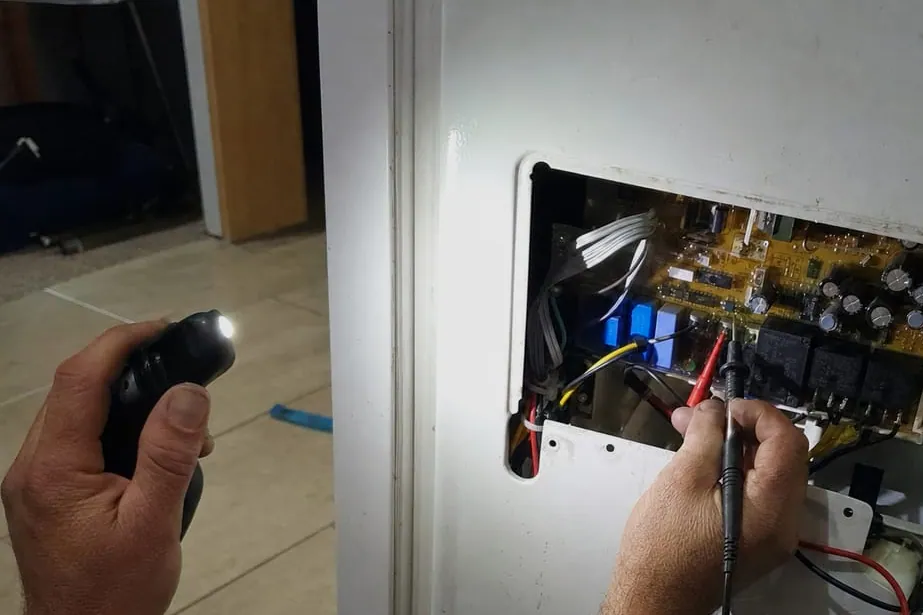
Control board read in place · inputs and outputs checked against the harness
01 The list
01
Sub-Zero
The core of the work. Built-in columns, side-by-sides, integrated units, freezer drawers and wine storage across the 300, 400, 500, 600 and 700 series, the BI line and the Designer range.
02
Wolf
Ranges, cooktops, wall ovens and warming drawers. Igniters, spark modules, thermocouples, oven sensors and control boards. Frequently in the same kitchen as the Sub-Zero, so often the same visit.
03
Cove
Dishwashers. Drain pumps, wash motors, door seals and control faults. A newer line, so the parts situation is straightforward.
04
Other built-ins
Viking, Thermador, Bosch, Miele and GE Monogram refrigeration turns up in the same kitchens. We take those calls where the fault is in territory we know well: refrigeration, sealed systems and airflow.
02 Parts
Why the part number matters more than the brand name
Two units of the same series and the same nominal model can take different boards depending on when they were built. That is why every order goes against the serial number rather than the model alone, and why the serial gets recorded at the start of the visit rather than looked for at the end.
Gaskets are the clearest example of why pattern parts are a poor idea on this equipment. A built-in door seals magnetically against a cabinet that is itself part of the joinery. A gasket with the wrong profile or the wrong magnet strength will look fitted and will not seal, and the customer ends up back where they started with a warm cabinet and a bill.
Boards are the second. A pattern board on a Sub-Zero can run the unit and still handle the defrost cycle differently, which produces an intermittent fault that is extremely hard to trace six months later.
Stated plainly House Services 24/7 is independent. Genuine parts, manufacturer-matched, without pretending to be something we are not.

03 Reviews
Customers with more than one unit
Called at six in the morning when the fresh food side had climbed to fifty. The tech found the evaporator fan seized behind the back panel, showed me the frost pattern before he touched anything, and had the part on the van. Back down to thirty-eight by the afternoon.
Our dual-zone wine unit was running warm on the top shelf only. He explained that the upper zone has its own damper and that the motor had failed open. Replaced it, ran the unit for forty minutes to confirm both zones held, and logged the temperatures for me.
04 Questions
Brand questions
Are you connected to Sub-Zero in any way?
No. We are an independent repair company. We fit genuine OEM parts and we work on the equipment every day, but we do not act for the manufacturer and we do not claim to.
Does that affect my warranty?
If the unit is still inside the manufacturer warranty, use the manufacturer route — you have already paid for it. Independent repair makes sense once that has expired, which is where the majority of the built-ins in Bay Area kitchens are.
Can you get parts for a discontinued model?
Often. Sub-Zero parts support for the 500 and 600 series is unusually good for equipment of that age, which is a large part of why those units are worth repairing at all.
Two brands, one kitchen, one visit?
Yes, if you mention it when booking so the slot is long enough and the van carries what both units need.
Tell the dispatcher the model number and what it is doing
It is stamped on a plate inside the fresh-food compartment, usually on the upper left wall or behind the top grille. With the model in hand the van gets loaded with the parts that unit actually fails on, which is the difference between one visit and two.