Ice maker had been making hollow cubes for months. The tech traced it to a partly blocked fill tube rather than the module itself, cleared it, then checked the inlet valve pressure so it would not come back.
Ice makers · modules and water lines
Sub-Zero ice maker repair
An ice maker is two systems bolted together: water getting in, and a module that freezes and ejects. Nearly every no-ice call is decided by finding out which of the two has stopped.
Call dispatch, any hour (669) 338-4601 Someone picks up at any hour. Same-day slots open and close through the day, so the dispatcher will tell you what is actually free when you call.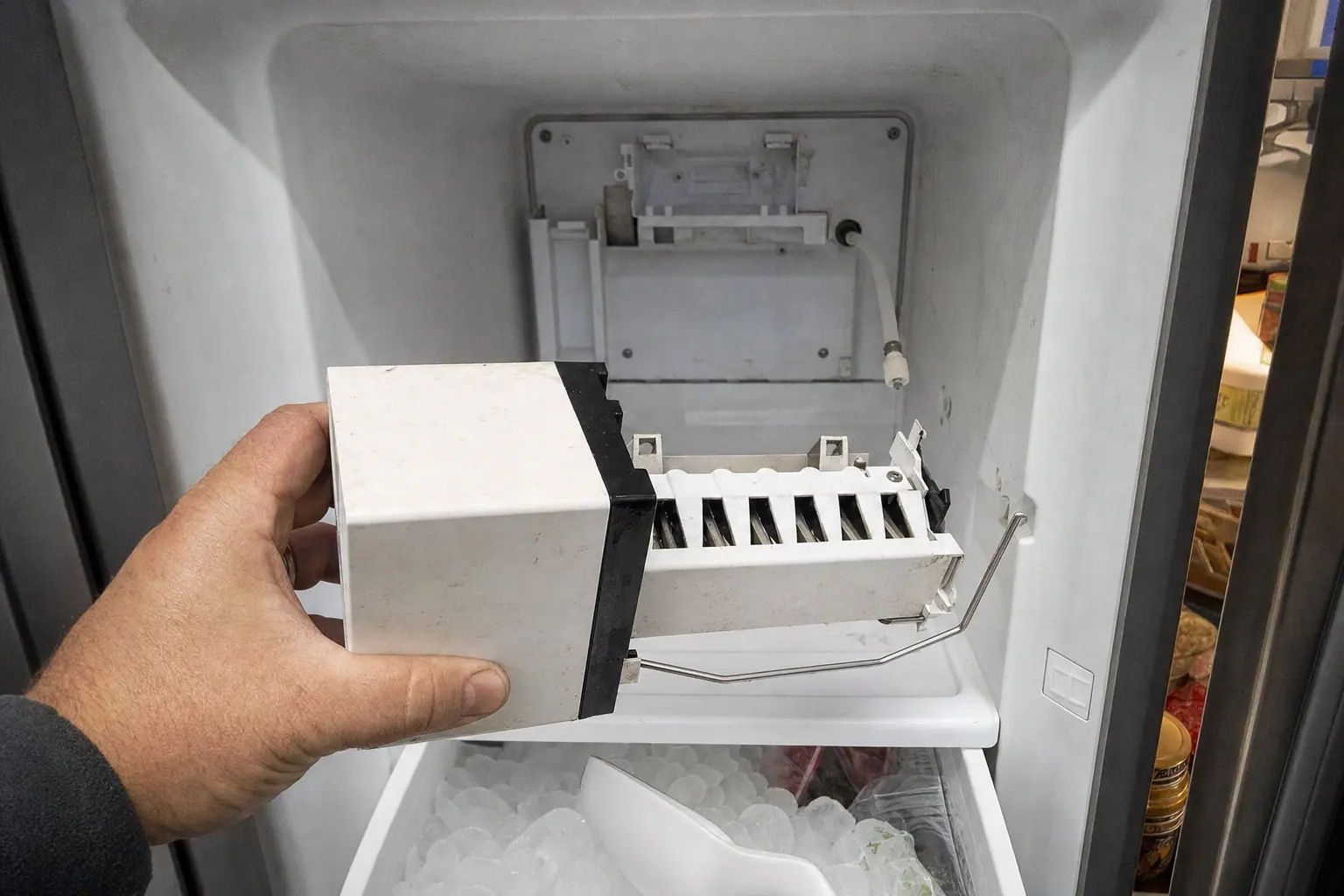
Ice maker module out · tested at the harness before it is condemned
01 Symptom to cause
Most no-ice calls are not the ice maker
Replacing the module is the expensive answer and often the wrong one. The order below is the order we work in, cheapest and most likely first.
| Symptom | Usual cause | What we do on site |
|---|---|---|
| No ice, no water arriving | Fill tube frozen, inlet valve failed, or the supply shut-off closed at some point and was never reopened | Line pressure checked at the valve, fill tube thawed and cleared, valve tested for coil resistance and flow. |
| Hollow or undersized cubes | Restricted fill, or low pressure so the mould fills partly before harvest fires | Fill volume timed, saddle valve and filter checked, restriction cleared or the valve replaced. |
| Water arrives, no harvest | Ice maker module: the motor, the thermostat or the harvest heater inside it | Module tested at the harness, and replaced as a unit if it fails. Ordered against the serial number. |
| Ice makes, then stops for days | Bail arm or the optical level sensor reading the bin as full when it is not | Sensor path cleaned and its output verified with the bin empty. Bail arm free travel checked. |
| Cloudy or bad-tasting ice | Filter past its life, a long stagnant run of line, or odour transfer inside the compartment | Filter replaced, line flushed, and the compartment checked for the seal fault letting odour in. |
| Water on the freezer floor under the maker | Fill tube overshooting the mould, or a split in the line behind the unit | Fill alignment corrected and the line inspected end to end, including where it passes behind the cabinet. |
02 Water line
The line behind the unit does most of the damage
Built-in refrigeration gets pushed back into a cabinet opening with almost no clearance, and the water line goes back with it. A kink put in on installation day can sit there for years, slowly restricting flow until the cubes start coming out hollow.
The other recurring fault is the shut-off. A lot of Bay Area kitchens still have a saddle valve tapped into a copper line under the sink. They silt up, they weep, and they are impossible to close properly when you actually need to. Where we find one we will say so, and fit a proper quarter-turn stop that you can reach.
If you are also seeing water on the floor rather than just bad ice, start at the leaking water page — the causes overlap but the diagnosis order is different.

03 Reviews
Ice maker calls, in their words
Ice maker module had to be ordered so it took a second visit, which they said upfront. Work itself was clean and the tech vacuumed the floor under the unit before he left.
The water line to the ice maker had been kinked behind the unit since installation. He fixed the routing, fitted a proper shut-off I can actually reach, and the ice has been right since.
04 Questions
Ice maker questions
The freezer is cold but there is no ice at all. Where do you start?
At the water side, not the module. A frozen or blocked fill tube and a failed inlet valve are both more common than a dead module, and both are cheaper. The module is tested last, after water has been proved to reach it.
Why are the cubes hollow or half-formed?
Not enough water is arriving in the mould before the harvest cycle fires. That is usually a partly restricted fill tube, low supply pressure at the valve, or a saddle valve on the house line that has silted up.
The ice tastes bad. Is that the machine?
Usually the water, the filter or an ice bin that has been sitting. Ice absorbs odours from an open freezer compartment. We check the filter age and the line, then look at the machine.
The whole bin has frozen into one block. What causes that?
Slow ice production plus partial melting, so cubes fuse. Behind it is usually a fill or harvest fault making the cycle run long, or a compartment sitting a few degrees warmer than it should.
Tell the dispatcher the model number and what it is doing
It is stamped on a plate inside the fresh-food compartment, usually on the upper left wall or behind the top grille. With the model in hand the van gets loaded with the parts that unit actually fails on, which is the difference between one visit and two.