Twenty-year-old 632. Two other companies told me to replace it. These people put gauges on it, found the low-side pressure was fine and the problem was a shorted defrost heater. Fixed for a fraction of what a new one costs.
Sealed systems · the expensive end
Sub-Zero sealed system and compressor repair
This is the one repair nobody should guess at. Compressors, condensers, driers and refrigerant leaks get diagnosed with instruments before anyone reaches for a torch.
Talk it through before you replace the unit (669) 338-4601 Someone picks up at any hour. Same-day slots open and close through the day, so the dispatcher will tell you what is actually free when you call.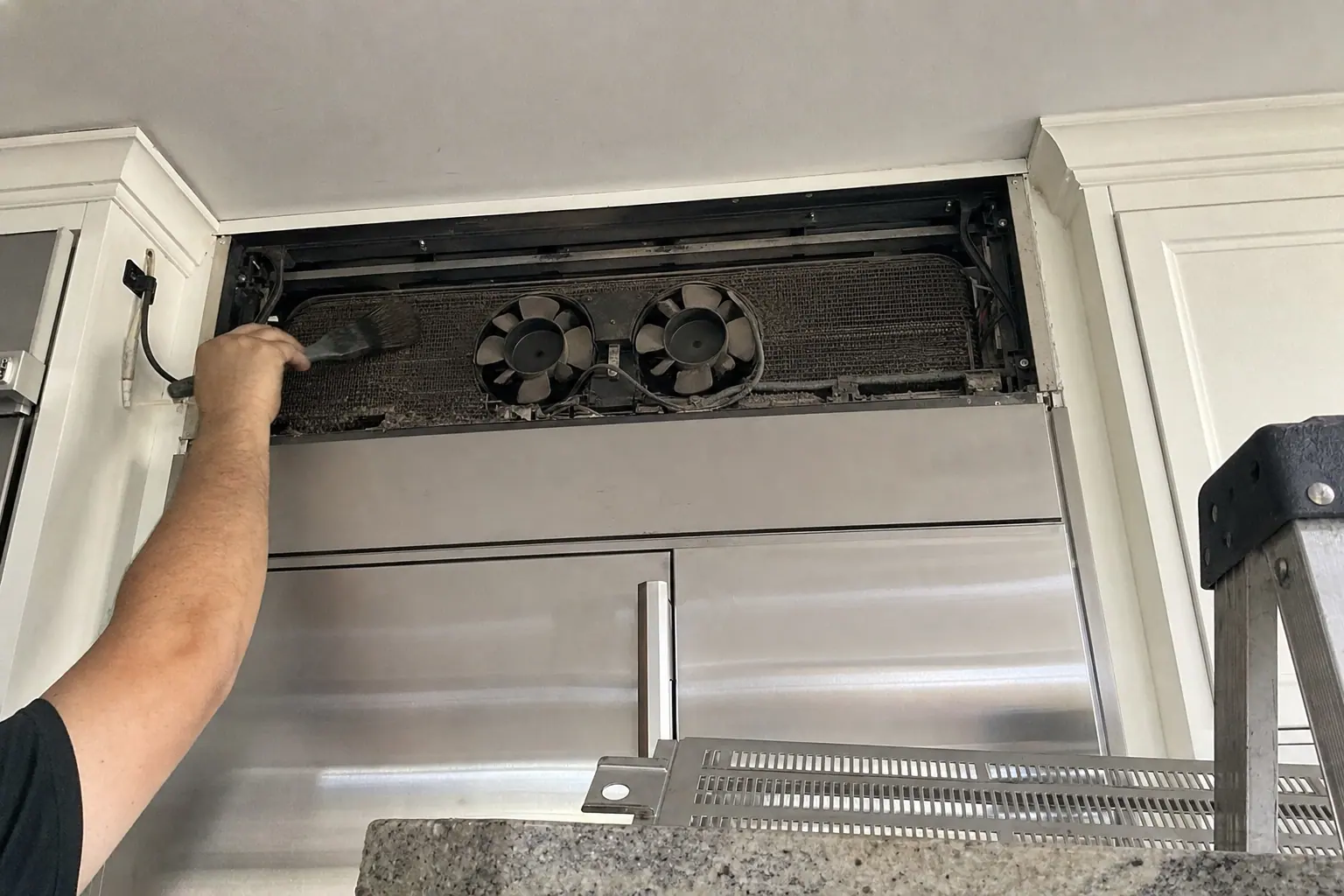
Condenser and its fans exposed · amp draw and head pressure measured before any conclusion
01 Diagnosis
What a real sealed-system diagnosis looks like
Plenty of visits end with a shrug and a recommendation to replace the unit. That is not a diagnosis, it is a way of avoiding one. Here is the actual sequence.
Rule out the cheap causes first. Condenser condition, condenser fan, evaporator fan, defrost circuit, door seals. If any of those explain the symptom, the sealed system is not opened at all.
Measure the compressor. Amp draw against the plate rating, start relay and overload tested separately. A compressor that draws nothing has a supply or relay problem; one that draws locked-rotor current has a mechanical one.
Read the system. Gauges on the process ports. Suction and discharge pressures, converted to saturation temperature, compared against the evaporator inlet and outlet. A restriction and a low charge look similar to a guess and completely different on gauges.
Find the leak. Electronic leak detector along the joints, the drier, the process tubes and the accessible runs. Where the leak is decides whether this is a repair or a conversation about the cabinet.

02 The repair
How the work is done
Sealed system work is the part of this trade where shortcuts show up months later, as a unit that cooled beautifully for six weeks and then did not.
-
Recovery
Whatever charge is left goes into a recovery cylinder. Nothing is vented to the kitchen or to atmosphere.
-
Component replacement
Compressor, drier and any failed line component fitted as genuine OEM parts matched to the serial number. The drier is replaced every single time the system is opened — it has already absorbed moisture the moment air gets in.
-
Pressure test
The system is pressurised with dry nitrogen and checked before a vacuum is pulled, so a bad joint is found while it is still easy to fix.
-
Evacuation
Pumped down to a deep vacuum and then held, isolated, to prove the system is tight and dry. If the vacuum rises, the leak is still there and the work is not finished.
-
Weighed charge
Refrigerant charged in by weight against the figure on the data plate, using a scale. Not by sight glass, not by feel on the suction line.
-
Run and verify
The unit is run down and the temperatures logged at the cabinet and the evaporator before we leave, so there is a record of where it was when the job finished.
03 Honest limits
When a sealed system repair is the wrong answer
If the leak is inside the foamed wall of the cabinet, there is nothing to get at. The tube is buried in insulation that was poured around it at the factory. A repair means cutting the liner, and the odds of a lasting result do not justify the work.
If the compressor has burned out and contaminated the system with acid, the clean-up is extensive and there is no guarantee against a repeat failure on an older unit.
In either case you will get the reasoning, not just a verdict. The $89 pays for finding out which situation you are in, and that answer is worth having before anyone quotes you for a replacement.
$89 service call — waived when you book the repair
04 Reviews
Sealed system calls, in their words
Compressor had failed on a built-in that is plumbed into the cabinetry. They did the sealed system work on site over two visits, pulled a proper vacuum and weighed the charge in rather than eyeballing it.
Told me honestly that the unit had a refrigerant leak in the wall of the cabinet and that repairing it was a gamble. Gave me the reasoning either way instead of just selling me the job.
05 Questions
Sealed system questions
How do you know it is the sealed system and not something cheaper?
By measurement. Suction and discharge pressures on gauges, compressor amp draw against the plate rating, evaporator inlet and outlet temperatures, and an electronic leak detector along the joints. A sealed system is not diagnosed by elimination.
Can a leak be repaired, or does the unit have to be replaced?
It depends where it is. A leak at a joint, at the drier, or in the accessible run behind the unit can be repaired. A leak inside the foamed cabinet wall usually cannot be reached, and we will tell you that rather than take money for a repair that will not hold.
Do you recover refrigerant properly?
Yes. Refrigerant is recovered into a recovery cylinder, never vented. The system is evacuated to a deep vacuum, held to prove it is tight, and recharged by weight against the plate figure rather than by feel.
Is an older unit worth a compressor?
Often, on 500 and 600 series built-ins, because the cabinet and the joinery around it are worth more than the compressor. On a unit that also has a cabinet-wall leak or heavy corrosion the answer flips, and we say so before you commit.
Tell the dispatcher the model number and what it is doing
It is stamped on a plate inside the fresh-food compartment, usually on the upper left wall or behind the top grille. With the model in hand the van gets loaded with the parts that unit actually fails on, which is the difference between one visit and two.