Called at six in the morning when the fresh food side had climbed to fifty. The tech found the evaporator fan seized behind the back panel, showed me the frost pattern before he touched anything, and had the part on the van. Back down to thirty-eight by the afternoon.
Symptom · not cooling
Sub-Zero not cooling
Warm cabinet, food at risk, and no obvious reason. Three faults cause most of these, and only one of them is expensive. The point of the visit is finding out which you have.
Warm right now? Call dispatch (669) 338-4601 Someone picks up at any hour. Same-day slots open and close through the day, so the dispatcher will tell you what is actually free when you call.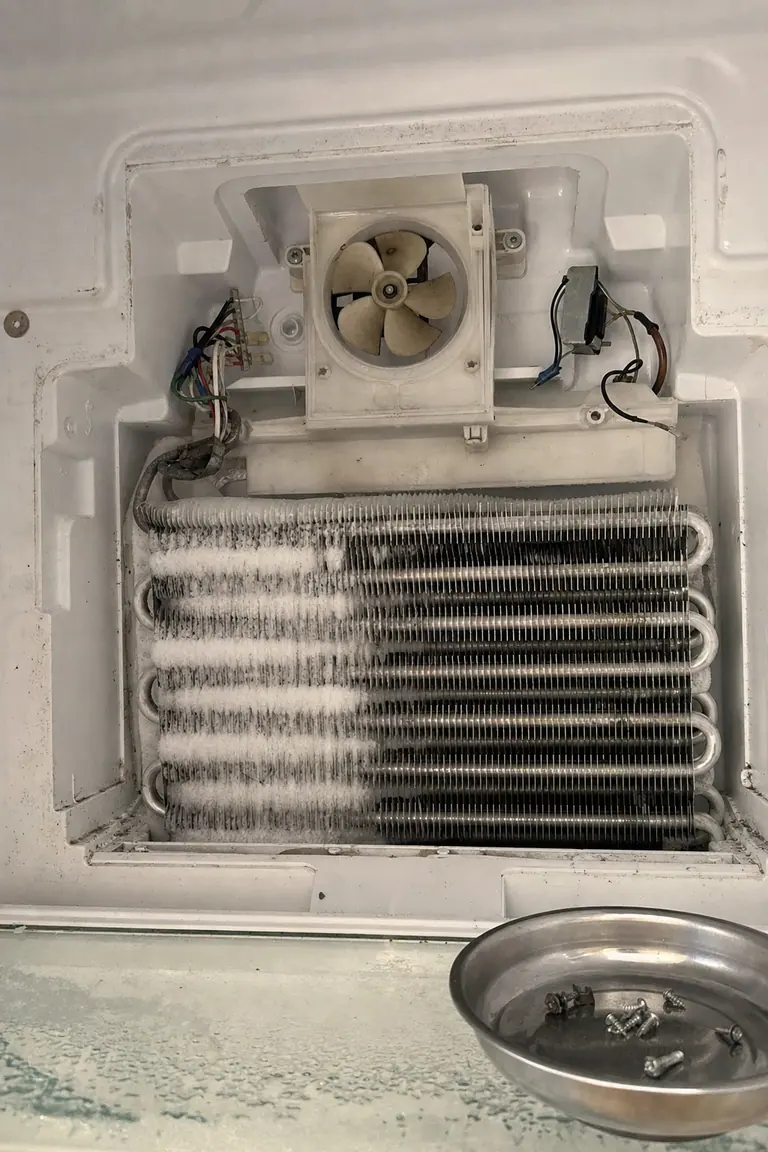
Rear panel off · the coil and the fan behind it are the first things measured
01 Before the van
What to do while you wait
None of this is a repair. It buys time and it makes the diagnosis faster.
-
Keep the doors shut
A closed, full refrigerator holds usable temperature for hours and a full freezer for considerably longer. Every opening resets that clock.
-
Put your hand on the grille
Air should be moving out of the upper grille and it should feel warm. If there is no movement at all, the condenser fan or the airflow path is your problem and it is a cheap one.
-
Listen at the back
A steady hum with nothing else is a compressor running. A click every few minutes followed by silence is a relay or overload cutting out, which is a different fault entirely. Either observation saves diagnostic time.
-
Write down the numbers
The model number, both display readings, and roughly when it started. Read those out when you call and the van gets loaded with the right parts.
02 Symptom to cause
Which of these is yours
The pattern matters more than the temperature. Which compartment is warm, and whether the unit is running, narrows it to one or two parts before anyone opens a panel.
| Pattern | Usual cause | What we do on site |
|---|---|---|
| Fridge warm, freezer still cold | Evaporator fan not turning, or the coil is iced solid and no air is reaching the fresh food side | Rear panel off. Fan tested for continuity and free rotation, frost pattern read, defrost heater and thermostat measured. |
| Both compartments slowly warming | Condenser choked with dust, or the condenser fan has stopped | Upper grille pulled, coil cleaned, condenser fan and its capacitor checked, compressor amp draw taken. |
| Nothing running at all | Supply, start relay, overload, or a failed control board | Voltage at the compressor terminals, relay and overload tested off the unit, board inputs and outputs verified. |
| Runs constantly, never gets cold | Refrigerant charge lost, or a restriction in the capillary or drier | Gauges on the process ports, saturation temperature compared with evaporator inlet and outlet, leak detector along the joints. |
| Cold for a day after a defrost, then warm again | Defrost circuit is dead — the ice returns on schedule | Defrost heater resistance, defrost thermostat continuity when cold, and the board defrost output all tested in turn. |
| Alarm on, temperatures actually fine | Thermistor has drifted, or a door is not closing square | Thermistor resistance read against the chart, gasket and hinge alignment checked. |
03 Airflow

A built-in cannot cool what it cannot cool
Built-in refrigeration rejects heat through a condenser sitting behind the upper grille, in a cabinet opening with very little air to spare. When that coil packs with dust and pet hair the unit does not stop working; it works harder, runs longer, and gradually loses ground.
The tell is a cabinet that has drifted up over weeks rather than failed overnight, plus a compressor that hardly ever cuts out. Cleaning the coil restores it, and on a fair number of calls that is the entire repair.
The second most common answer is defrost. Every unit ices its evaporator in normal running and clears it on a cycle. When the heater or the thermostat quits, the ice stays, thickens, and eventually blocks the coil completely — at which point the fan is running and moving nothing. Sealed system faults come third, and are proved with gauges rather than assumed.
04 Reviews
Warm-cabinet calls, in their words
Straight about money. Eighty-nine to come out and diagnose, and it came off the repair when I said yes. No hedging, no surprise line items at the end.
Freezer at fifteen degrees, fridge fine. He knew straight away it was the freezer evaporator and not the compressor, which meant a much smaller job than I had braced for.
05 Questions
Questions we get at 2am
How long can food stay safe while I wait?
A full, closed refrigerator holds usable temperature for a few hours; a freezer holds longer, roughly a day if it is full and stays shut. Keeping the doors closed does more good than anything else you can do.
The compressor is running. Does that mean it is not the compressor?
Not on its own. A compressor can run and still be doing no useful work if the system has lost its charge or a valve has failed internally. It does mean the supply, relay and overload are intact, which narrows things.
Should I unplug it and let it defrost overnight?
That will often restore cooling for a few days, which is useful if you need to save food. It does not fix anything: if the coil iced over once because the defrost circuit failed, it will ice over again.
Is a warm fridge always an expensive repair?
No, and that is the point of measuring first. A blocked condenser, a failed evaporator fan and a dead defrost heater all produce a warm cabinet, and all three are ordinary parts jobs.
Tell the dispatcher the model number and what it is doing
It is stamped on a plate inside the fresh-food compartment, usually on the upper left wall or behind the top grille. With the model in hand the van gets loaded with the parts that unit actually fails on, which is the difference between one visit and two.