A portable fridge works by pumping heat out of an insulated box, using one of 3 systems: a small compressor driving a sealed refrigerant loop, a thermoelectric (Peltier) module that moves heat when 12-volt current flows through it, or an absorption circuit powered by a flame or heating element. The compressor type behaves most like a kitchen refrigerator, holding 40°F for food or pulling down toward 0°F for frozen goods, while the other 2 designs trade cooling power for silence or fuel flexibility.
None of the 3 portable fridge designs creates cold; each carries heat from the cabinet to the outside air, which is why every unit has a warm side, a vent or a fan. The method a unit uses explains most owner complaints, and the same physics runs a built-in Sub-Zero refrigerator at a larger, more tightly controlled scale.
How does a compressor portable fridge move heat?
A compressor portable fridge runs the same vapor-compression cycle as a household refrigerator. The compressor squeezes refrigerant vapor, raising its pressure and temperature. The hot gas flows through a condenser behind a vent, where a fan sheds the heat and the refrigerant condenses into a liquid. The liquid passes through a narrow capillary tube, drops in pressure, and boils inside the evaporator, the cold plate lining the box, absorbing heat from the food before returning to the compressor.
A portable fridge controller switches the compressor on and off to hold the setpoint. Most compressor units run on 12-volt or 24-volt DC from a vehicle, and many accept 120-volt AC through an adapter. Many compact units use a hydrocarbon refrigerant such as R-600a (isobutane).
The compressor design explains the common complaints. A blocked vent traps condenser heat, so the compressor runs longer and the box warms. A low-voltage cutoff shuts the compressor off to protect a vehicle's starting battery, which owners often read as a dead fridge. Frequent lid openings let humid air in, and that moisture freezes on the evaporator plate as frost.
Why does a thermoelectric cooler only get cool, not cold?
A thermoelectric portable fridge has no refrigerant and no moving parts except its fans. The core is a Peltier module: semiconductor junctions between two ceramic plates. When 12-volt current flows through the Peltier module, one plate gets cold and the other gets hot, and finned heat sinks with fans spread each side into the air.
Thermoelectric cooling is relative to the surrounding air: the Peltier module can only hold the inside a limited number of degrees below the outside temperature, so a cooler that feels fine in a garage struggles in a parked car in July. The thermoelectric design also draws power continuously and rarely cycles off. A failed outside fan lets the hot plate overheat and cooling nearly stops, and many units can reverse current to warm the box, so a switch left on the heat setting is an easy fix.
What makes an absorption fridge cool with a flame?
An absorption portable fridge, common in campers and in three-way units that run on gas, 12-volt DC or 120-volt AC, uses heat instead of a motor. A gas flame or heating element warms a solution of ammonia and water in a sealed steel circuit. The ammonia boils off, condenses in finned tubes at the back, then evaporates into hydrogen inside the cooling coil, pulling heat out of the box. Water reabsorbs the ammonia and the solution returns to the heater by gravity, with no pump.
An absorption fridge depends on gravity, so the cabinet must sit close to level; parked on a slope, the solution can pool and cooling stalls. Absorption units also need airflow across the rear fins and cool slowly from a warm start. A yellowish residue near the burner or a sharp ammonia smell means the fridge should be shut off and left to a specialist.
How do Sub-Zero built-ins compare with portable fridges?
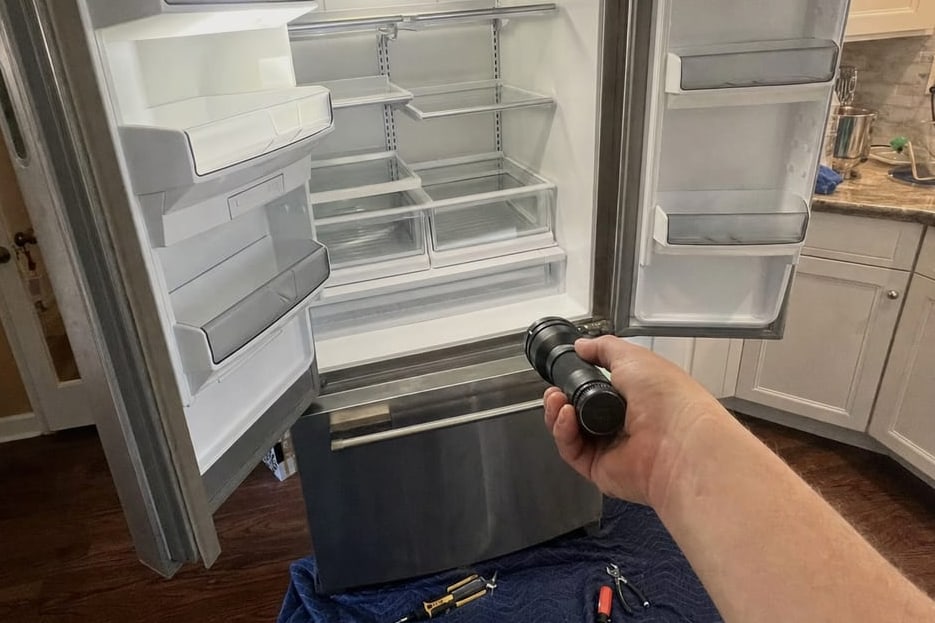
A built-in Sub-Zero refrigerator uses the same vapor-compression loop as a compressor portable fridge, but with more separation and control. Sub-Zero's Dual Refrigeration gives the refrigerator and the freezer their own individual cooling systems, which keeps fresh-food odors out of frozen food and ice and avoids freezing the moisture out of the fresh-food section's air.
On PRO Series units, Dual Refrigeration runs through 3 separate controls, so the refrigerator, the refrigerator drawers and the freezer each hold their own temperature, set from 2 touch displays on the grille. A portable fridge usually has one compartment and one thermostat.
Sub-Zero 200 and 300 Series combination units encode the system count in the model number: the number of 1s matches the number of compressors and temperature controls. A 361RFD has one, a 3211RFD has two, and model 211 is the exception with one. On Classic (BI, CL) and 200/300 Series over-and-under models, the serial tag sits inside the refrigerator door near the top hinge.
Can an owner recharge the sealed refrigerant loop?
The sealed system in a compressor portable fridge or a built-in Sub-Zero is not an owner repair. Under the 2017 UL 60335-2-24 standard that EPA adopted in 2018, each separate refrigerant circuit in a household refrigerator or freezer using R-600a, R-290 or R-441A may hold no more than 150 grams (5.29 ounces), replacing EPA's earlier 57-gram limit. Those refrigerators mark the pipes, hoses and devices that carry refrigerant in red PMS #185.
Current Sub-Zero guides warn that the appliance contains flammable refrigerant and that only refrigeration technicians trained on flammable refrigerants may work on it. EPA also allows R-600a, R-290 and R-441A only in new equipment designed for them, so a refrigerator built for a different refrigerant cannot be converted to a hydrocarbon substitute.
Owner checks, symptom by symptom
Compressor portable fridge shuts off in the car: the low-voltage cutoff is the likely cause when the battery sags. Check the battery-protection setting and the 12-volt socket, then try the AC adapter at home; if the compressor still will not start on steady power, call a technician.
Thermoelectric cooler barely cool: the Peltier module is fighting hot air or a stalled fan. Listen for the outside fan and move the cooler into shade; a silent fan or a room-temperature cold plate means a failed part.
Absorption camper fridge weak: an off-level cabinet or blocked rear fins is the usual cause. Level the camper, clear the vent, and allow several hours to pull down from warm.
Built-in Sub-Zero warm in one section only: Dual Refrigeration keeps the refrigerator and freezer on separate systems, so one compartment can fail while the other stays cold. Confirm the setpoint and that the door gaskets close fully; a warm section with correct settings points to a sealed-system, fan or control fault for a technician.